How to Source Arrow Warning Boards from Reliable Suppliers?

Sourcing Arrow warning boards from reliable suppliers requires more than comparing catalog prices. The right supplier must prove performance, consistency, and after-sales responsibility. A board may look impressive in a product photograph, yet fail when rain covers its lens or vibration loosens its frame.

Michael R. Jackson, an independent traffic-control equipment consultant, states, “A bright arrow matters only when it remains reliable under pressure.” This practical view should guide every purchasing decision. Buyers should inspect LED brightness, arrow visibility, viewing distance, housing strength, battery life, and control-panel response. Ask for product samples, test reports, factory photographs, and clear warranty terms. Do not accept vague promises.

Details reveal competence.

Reliable suppliers usually provide traceable specifications, stable production records, and responsive technical support. Their answers should explain how Arrow warning boards perform in heavy rain, dusty roadside conditions, and repeated transportation. Check whether replacement modules, batteries, and controller parts remain available. A low initial price can become expensive when one damaged component stops an entire unit.

Supplier evaluation is rarely perfect. A polished website does not prove manufacturing ability, and one successful sample cannot guarantee every future batch. Buyers should compare several suppliers, request written commitments, and record unanswered questions. Factory audits or independent inspections can reduce uncertainty. Still, judgment is required.

This guide examines practical sourcing methods, supplier verification steps, quality indicators, and common purchasing mistakes. It focuses on evidence, not impressive claims, so procurement teams can choose Arrow warning boards with greater confidence.
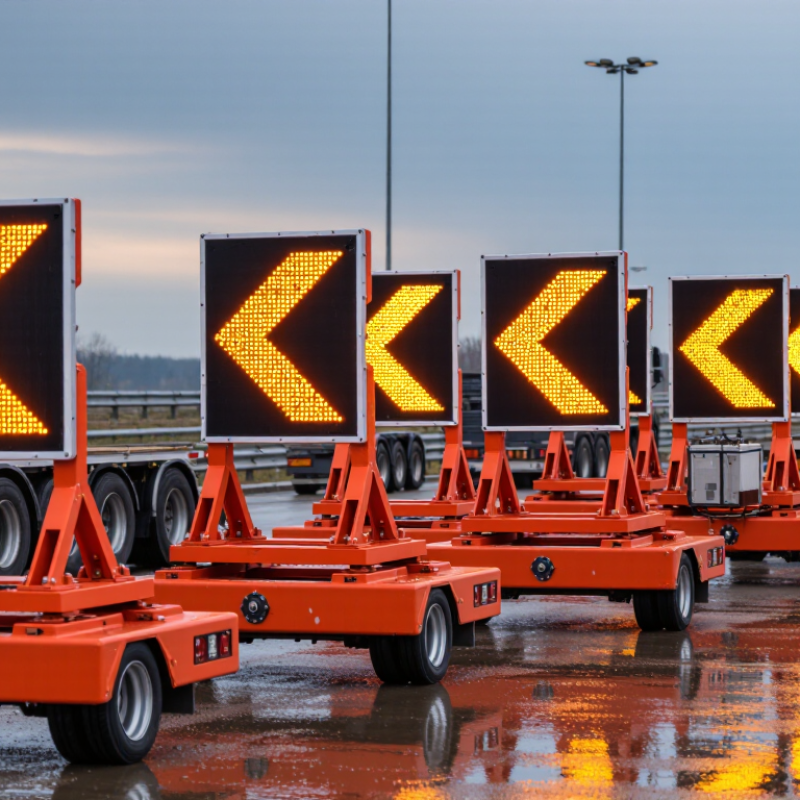
How to Source Arrow Warning Boards from Reliable Suppliers?

Define Arrow Warning Board Requirements and Compliance Standards

How to Source Arrow Warning Boards from Reliable Suppliers?

Define Arrow Warning Board Requirements and Compliance Standards

Before requesting quotes, define the operating scene, not only the board size. Record approach speed, lane width, viewing distance, wind exposure, weather, and deployment time. FHWA’s 2023 Manual on Uniform Traffic Control Devices recognizes Type A, B, and C arrow-board applications. Choose the class from road conditions and the approved traffic-control plan. Guesswork is expensive.

Require readable arrow displays under direct sun, rain, and nighttime conditions. Specify LED performance, flash patterns, enclosure protection, battery autonomy, charging method, mounting stability, and controller diagnostics. Ask for model-specific photometric tests, electrical safety evidence, materials data, and production inspection records. A supplier should explain how each result matches the applicable MUTCD section and local transportation authority rules. “Compliant” alone proves little.

FHWA recorded 891 work-zone fatalities in the United States during 2022, showing why visibility and placement deserve engineering attention. During supplier audits, inspect a powered sample outdoors and measure legibility from the planned distance. Check arrow uniformity across pixels. Confirm spare parts, firmware control, warranty response, and calibration records. Also verify transport restraints and ballast calculations. These details reveal operational experience. A checklist can still miss human error. Ask installers to document setup photos and pre-shift inspections. Requirements may change, and perfect documentation cannot guarantee a perfect roadside installation.

Research Supplier Capabilities, Experience, and Product Certifications

Sourcing reliable arrow warning boards starts with checking a supplier’s real capabilities. Ask how they control reflective films, aluminum sheets, LED modules, and mounting hardware. A capable factory should explain production steps clearly, from cutting and printing to final inspection. Request photos of working samples, not only polished catalog images. Small details matter. Check edge finishing, arrow brightness, cable protection, and weather resistance.

Experience is equally important. Suppliers serving road contractors for several years usually understand installation errors and field conditions. Ask for anonymized project records, inspection procedures, and batch traceability documents. Product certifications should match the destination market and board design. Review valid test reports for visibility, electrical safety, ingress protection, and material durability. Certification alone is not enough. Confirm the testing laboratory, report date, sample model, and applicable standard. Requirements can differ between countries, and suppliers may present outdated documents. I have seen attractive samples fail because their reflective performance was never verified after outdoor exposure.

Tips: Request one sample before placing a large order. Compare brightness in daylight, rain, and low light. Ask for a written quality checklist and replacement policy. Check whether the supplier can maintain consistent dimensions across batches. Do not guess. A short video call through the workshop can reveal production capacity, storage conditions, and testing equipment. Leave room for reflection, too; a supplier may meet specifications while still communicating poorly or responding slowly. Reliability includes both product performance and dependable cooperation.

How to Source Arrow Warning Boards from Reliable Suppliers? - Research Supplier Capabilities, Experience, and Product Certifications

Supplier Profile Manufacturing Experience Core Production Capability Typical Board Materials Retroreflective Performance Quality Management Evidence Product and Safety Standards to Verify Customization Capability Quality-Control Records to Request Overall Screening Result
Profile A 10+ years producing traffic-warning and directional signage In-house cutting, screen or digital printing, film application, drilling, bending, and final inspection Aluminium sheet, galvanized steel, and aluminium composite panel High-intensity or diamond-grade retroreflective sheeting options; photometric test report required ISO 9001 certificate with current scope covering traffic-sign or metal-sign production Verify EN 12899-1, EN ISO 7010, ASTM D4956, or the applicable national road-sign specification Custom arrow direction, dimensions, mounting holes, borders, colors, legends, and reflective grades Incoming-material inspection, color-control record, dimensional report, adhesion test, and final visual inspection Strong candidate
Profile B 5–9 years in fabricated metal signage and safety identification products Sheet-metal forming, powder coating, vinyl application, assembly, and outsourced reflective-film conversion Powder-coated steel and mill-finish aluminium Engineer-grade and high-intensity options; confirm the film manufacturer, lot traceability, and warranty terms ISO 9001 certificate or documented quality procedures available for review Request evidence of compliance with the destination market’s traffic-sign retroreflectivity and color requirements Standard and moderate customization; complex graphics may require pre-production approval Material certificates, coating-thickness records, print-proof approval, packing inspection, and sample retention Verify before approval
Profile C 15+ years supplying commercial, construction, and road-safety signage Automated CNC routing, digital printing, reflective-film lamination, edge finishing, and batch inspection Aluminium, aluminium composite panel, and flexible temporary-sign substrates High-intensity and diamond-grade options; independent photometric testing recommended for critical projects ISO 9001 and environmental-management documentation available for audit Check EN 12899-1 or ASTM D4956 classification, UV-resistance data, and applicable local authority approvals Strong capability for multilingual legends, variable arrows, serial numbers, QR codes, and multiple mounting systems Color measurement, reflectivity testing, substrate thickness, edge-quality, packaging, and pre-shipment inspection reports Strong candidate
Profile D 2–4 years focused mainly on general promotional and indoor signage Basic cutting and printing; reflective-film application and metal fabrication partly outsourced Aluminium composite panel and PVC-based sheet Reflective grade not consistently specified; laboratory or supplier test evidence required No independently verified quality-management certification presented Product-specific compliance with road-sign standards has not been demonstrated Good for simple shapes and low-volume orders; limited control over specialized mounting and durability requirements Request substrate certificates, reflective-film traceability, adhesion results, color data, and production samples Higher risk
Profile E 8–12 years manufacturing temporary traffic-control and work-zone products Folding, riveting, screen printing, reflective sheeting application, frame assembly, and field-repair support Aluminium sheet, galvanized steel, and corrugated plastic for temporary use High-intensity reflective options for temporary traffic management; confirm service-life and cleaning requirements ISO 9001 documentation should be checked against the issuing body and certificate scope Verify applicable work-zone requirements, EN 12899-1 or ASTM D4956 classification, and local traffic authority rules Portable bases, foldable frames, weighted stands, custom arrow layouts, and replacement-face production Wind-load assessment, frame-strength test, reflective-film lot records, hinge inspection, and packaging verification Suitable for temporary use
Profile F 10+ years as a contract manufacturer for industrial safety and facility signage Laser cutting, CNC bending, powder coating, digital printing, lamination, and controlled final assembly Aluminium, galvanized steel, stainless steel, and rigid composite panels Reflective performance depends on selected film; require sample testing under the intended viewing and lighting conditions ISO 9001 available; ISO 14001 or ISO 45001 may support broader supplier-risk evaluation Verify EN ISO 7010 symbols where applicable and confirm that road-use requirements are separately met High customization for industrial sites, warehouses, private roads, bilingual signs, and serialized assets Material traceability, dimensional inspection, coating adhesion, symbol review, artwork approval, and final release checklist Suitable after compliance review

Screening note: Certification claims, test reports, reflective grades, and standard compliance should be validated against the supplier’s current certificates, product scope, issuing body, batch records, and destination-market requirements before purchase.

Compare Materials, Specifications, Prices, and Customization Options

Sourcing arrow warning boards requires more than comparing catalog prices. Material choice affects weight, durability, visibility, and installation time. Aluminum is light and resists corrosion, making it suitable for frequent relocation. Galvanized steel feels stronger but adds weight and may need better edge protection. Plastic boards can reduce costs, yet their performance depends heavily on thickness and temperature resistance. Check the surface carefully. Reflective sheeting should remain clear after rain, dust, and repeated cleaning.

Specifications should match the working environment. Confirm board dimensions, arrow shape, color contrast, mounting-hole positions, border width, and reflective grade. Ask for test reports, material certificates, and sample photographs under daylight and low light. A reliable supplier should explain tolerances instead of promising “perfect” production. Small details matter. A two-millimeter hole shift can delay installation across an entire batch. Request packaging details too, especially for stacked boards with vulnerable corners.

Price comparisons become useful only when quotations include the same specifications. One supplier may exclude brackets, protective film, printing plates, or delivery packaging. Custom options may include warning text, folding frames, handles, magnetic panels, and special colors. These features improve field use, but they also raise tooling and inspection costs. Do not select the lowest number too quickly. A cheaper board may fade sooner or require replacement hardware. I would also question unusually low prices and recheck every assumption before ordering. A small pilot order can reveal defects that samples hide. Supplier traceability, responsive communication, and consistent batch quality deserve a clear place in the purchasing decision.

Verify Samples, Manufacturing Quality, and Delivery Reliability

How to Source Arrow Warning Boards from Reliable Suppliers?

Reliable sourcing starts with physical samples, not attractive catalog photos. Request a production sample matching the final board’s size, arrow pattern, materials, and lighting method. Check the reflective surface under daylight and at night. Inspect the aluminum or plastic panel for warping, sharp edges, weak joints, and uneven printing. Ask for material specifications, test reports, and quality-control records. These documents should match the actual sample, not a generic file.

Manufacturing quality appears in small details. Review adhesive coverage, cable protection, battery housing, fastening points, and warning-light brightness. Ask how workers control color consistency between batches. A factory visit or live video inspection can reveal storage conditions and assembly practices. Still, no inspection is flawless. A sample may look excellent while later batches show minor defects. Define acceptance standards clearly, including allowable scratches, brightness variation, packaging damage, and rework procedures.

Tips: Request two samples from different production runs. Confirm the inspection checklist before placing an order. Ask for dated production photos and carton images. Verify the shipping schedule, loading date, tracking process, and response time for delays. A dependable supplier should explain capacity limits honestly, rather than promise everything immediately. Add a reasonable delivery buffer, especially for customized boards. Keep written records of approved samples and revisions. Small changes can create expensive confusion. Reliability is proven through repeated communication, consistent workmanship, and deliveries that match the agreed specifications.

Evaluate Contracts, Support Services, and Long-Term Supplier Fit

How to Source Arrow Warning Boards from Reliable Suppliers?

Start with the contract. Specify board dimensions, arrow direction, substrate, reflective performance, color tolerance, edge finishing, and packaging. Include approved drawings and a pre-production sample. The World Bank’s Logistics Performance Index 2023 shows that shipment tracking remains a major logistics differentiator, so require batch numbers and delivery milestones. Define inspection rights, rejection procedures, replacement deadlines, warranty coverage, and change-control rules. Vague quality language creates expensive arguments later.

Support services reveal long-term supplier fit. Ask whether technical staff can review mounting details, artwork changes, and field damage. Require response-time targets, spare-unit availability, and written corrective-action reports. The ISO Survey 2023 recorded more than 1.2 million ISO 9001 certificates worldwide, yet certification alone proves limited operational ability. Audit production records, calibration evidence, and reflective-material testing. Request two recent customer references. Check whether their order volume matches your forecast. Bigger is not always safer.

Price still attracts attention. That bias is difficult to remove. McKinsey’s supply-chain research has repeatedly shown that resilience requires visibility, alternative capacity, and stronger supplier collaboration. Add a continuity clause covering material shortages, transport delays, and controlled substitutions. Review performance quarterly using defect rates, on-time delivery, support response, and complaint closure. I would not treat a perfect supplier score as permanent. Arrow boards face weather, handling damage, and changing site needs, so the contract should allow practical improvement without weakening safety requirements.

Go to Top