
China Top 10 Rubber Wheel Stops Manufacturers?
China has become a major manufacturing base for parking, logistics, and traffic-safety equipment. This makes selecting the right Rubber wheel stops more difficult than comparing catalog prices. Factory photos rarely reveal rubber density, anchor quality, ultraviolet resistance, or installation consistency.
Industry data supports this broader market context. Grand View Research’s Rubber Market Size, Share & Trends Analysis Report identifies transportation and infrastructure as important rubber-consuming sectors. The Freedonia Group’s World Rubber & Rubber Products analysis also highlights continued demand from construction, mobility, and industrial applications. These reports do not rank wheel-stop suppliers directly. However, they explain why material traceability and production capability deserve closer attention.
This guide reviews China’s top 10 Rubber wheel stops manufacturers through practical purchasing criteria. We consider product dimensions, recycled-rubber content, reflective markings, compression performance, mold quality, and fixing hardware. A 550-millimeter wheel stop may look simple, yet weak anchors can fail under repeated vehicle impact. Poorly bonded reflectors may also disappear after months of rain, dust, and tire contact.
Standards matter.
Relevant references include ASTM D395 for rubber compression set, ASTM D2000 for rubber material classification, and ISO 9001 quality-management principles. These standards cannot guarantee every product’s field performance. They provide a more reliable framework for supplier comparison.
Our assessment combines manufacturer documentation, export experience, technical responses, and visible product evidence. Rankings remain subjective. Some suppliers may offer stronger customization than their public profiles suggest. That limitation deserves acknowledgment. Buyers should still request samples, test certificates, loading guidance, and installation instructions before placing a large order.
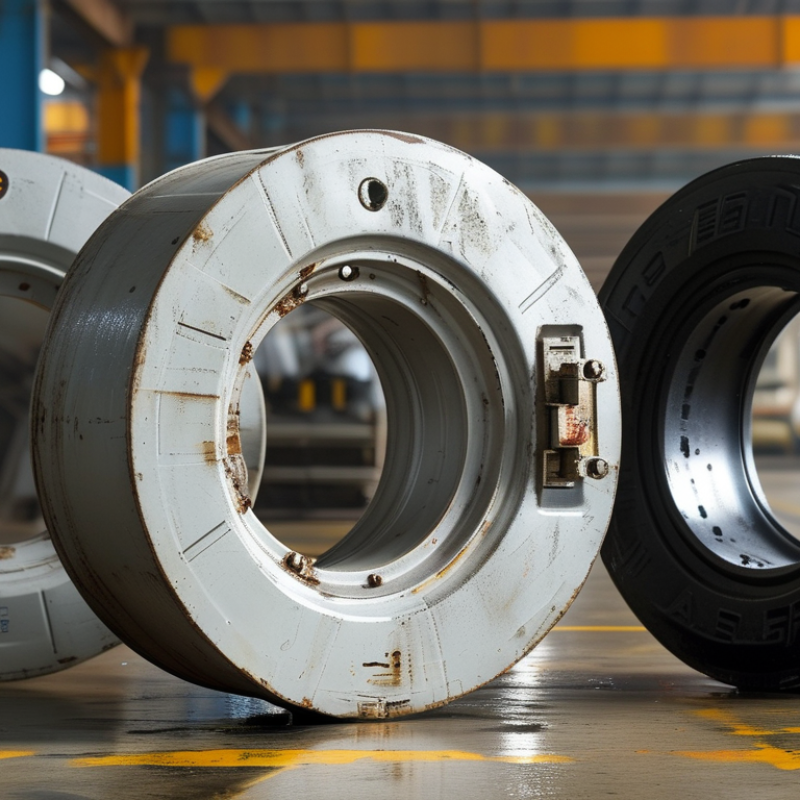
Definition and Role of Rubber Wheel Stops
Rubber wheel stops are compact parking-control devices made from dense, weather-resistant rubber. They mark the correct stopping point and prevent vehicles from moving too far forward. In busy lots, they protect walls, fences, walkways, and loading areas from repeated contact. Their dark, high-contrast shape also helps drivers judge distance during rain, darkness, or crowded conditions.
A well-designed stop usually includes reflective panels, mounting holes, and a stable base. Rubber absorbs some impact and creates less noise than concrete. It also handles minor vehicle mistakes without easily cracking. However, it is not a complete safety system. Poor anchoring, weak surfaces, or incorrect spacing can reduce its effectiveness. A site inspection should consider vehicle size, turning angles, drainage, and pedestrian movement. Small details matter here.
Tips: Measure the parking bay before installation. Keep stops evenly aligned. Use suitable anchors for the ground material. Check bolts and reflective areas regularly, especially after heavy rain or winter exposure. Leave enough clearance for bumpers and wheelchairs. From practical installation work, one common mistake is positioning stops too close to the curb. It may look neat, but it can create unnecessary tire pressure and make parking less comfortable. Review the layout after real vehicles use the space.
| No. | Anonymous Manufacturer Profile | Typical Product Configuration | Common Size Range (L × W × H) |
Primary Material | Visibility Features | Typical Fixing Method | Main Application | Role of the Wheel Stop |
|---|---|---|---|---|---|---|---|---|
| 1 | Profile A | Heavy-duty straight rubber wheel stop | 1,650–1,830 × 150 × 100 mm | Recycled SBR rubber | Yellow reflective strips | Two or three anchor bolts | Commercial parking areas | Defines the front parking limit and helps prevent vehicles from contacting walls or barriers. |
| 2 | Profile B | Low-profile rubber parking curb | 1,650–1,830 × 100 × 100 mm | Recycled rubber compound | Molded-in reflectors | Expansion anchors | Residential and office parking | Provides a visible stopping position while reducing the risk of bumper and tire impact. |
| 3 | Profile C | Heavy-vehicle rubber curb stop | 1,830–2,000 × 200 × 150 mm | High-density SBR rubber | High-visibility yellow bands | Four or more anchor bolts | Truck and fleet parking zones | Creates a robust visual and physical boundary for larger vehicles. |
| 4 | Profile D | Parking bay rubber separator | 1,650–1,830 × 150 × 100 mm | Rubber with EPDM surface options | Reflective tape | Bolted installation on concrete | Shopping centers and public car parks | Standardizes vehicle alignment and protects pedestrian walkways, landscaping, and structures. |
| 5 | Profile E | Wheel stop with integrated cable channel | 1,650 × 150 × 100 mm | Recycled rubber | Amber reflective panels | Anchor bolts through molded holes | Parking areas with charging equipment | Controls vehicle position and can help keep low-voltage cables away from tire paths. |
| 6 | Profile F | Compact rubber wheel stop for narrow bays | 900–1,200 × 150 × 100 mm | Natural and synthetic rubber blend | Contrasting end markings | Two anchor bolts | Small parking spaces and garages | Offers a controlled stopping point where a full-length parking curb is impractical. |
| 7 | Profile G | Temporary or relocatable rubber wheel stop | 900–1,650 × 150 × 100 mm | Dense recycled rubber | Built-in reflective inserts | Removable bolts or surface adhesive | Events, temporary lots, and construction sites | Allows parking layouts to be changed with less surface disruption than permanent concrete stops. |
| 8 | Profile H | Rubber stop with molded drainage clearance | 1,650–1,830 × 150 × 100 mm | Weather-resistant SBR rubber | Reflective yellow sections | Three anchor bolts | Outdoor lots in wet climates | Maintains a defined stopping line while allowing surface water to pass beneath or around the unit. |
| 9 | Profile I | High-visibility rubber parking barrier | 1,830 × 150 × 100 mm | Black rubber with EPDM color inserts | Black-and-yellow contrast | Heavy-duty expansion anchors | Hospitals, airports, and industrial sites | Improves daytime recognition and nighttime guidance in high-traffic parking environments. |
| 10 | Profile J | Custom-sized rubber wheel stop | Made-to-order; commonly 1,000–2,000 × 100–200 × 80–150 mm | Customized rubber compound | Optional reflective markings | Fixings matched to the pavement | Ports, logistics yards, and specialized facilities | Adapts the stopping position, height, and footprint to site-specific vehicle and safety requirements. |
Related Posts
-
Best Height Clearance Bars for Global Buyers in 2026?
-

How to Choose the Best Parking Space Barriers for 2026?
-

China Best Dome Safety Mirrors for Enhanced Visibility and Security?
-

What is an Arrow Warning Board and Why is it Important?
-

2026 Top Parking Lot Stencils Buyers Guide Questions
-

Top Quality Lane Separator Curbs from China for Global Buyers?