Solar delineator posts are compact roadside devices that improve visibility along curves, junctions, bridges, and narrow shoulders. They usually combine a reflective body, photovoltaic panel, rechargeable battery, and low-energy LED. During daylight, the panel converts sunlight into electrical energy. The battery stores that energy. After dusk, a light sensor activates the LED automatically.
The effect is simple but practical. A driver sees repeated points of light instead of an uncertain road edge. In rain, fog, or dusty conditions, that extra visual rhythm can help reveal alignment. Solar delineator posts also avoid trenching for conventional power cables, which may reduce installation disruption. Still, they are not magic. Heavy shade, dirty panels, weak batteries, or poor spacing can reduce their value. Field inspections often expose problems that product brochures overlook.
Road-safety researcher Fred Wegman has argued, “The road should be designed in such a way that it is forgiving of human errors.” That principle explains why these posts deserve careful evaluation, not automatic approval. Their performance depends on location, mounting height, beam visibility, charging conditions, and maintenance access. A post that flashes brightly in a showroom may perform differently beside a tree-lined road. Designers should examine nighttime visibility, battery reserve, impact resistance, and long-term weather exposure. The details matter. This guide explores what Solar delineator posts are, how their components work together, and where their practical limitations appear. It also considers a point that is easy to miss: reliable road guidance comes from the whole system, not one glowing device.
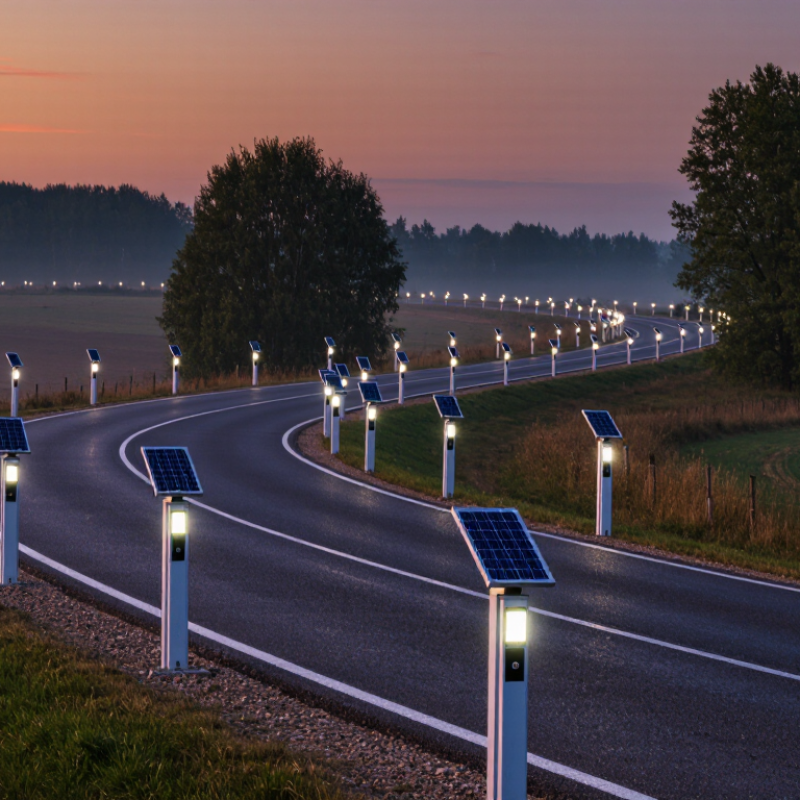
Solar delineator posts are roadside markers that show drivers where pavement edges, curves, and hazards begin. Their main purpose is guidance, not physical protection. Each post usually combines a reflective panel, a small solar module, an LED, and a rechargeable battery. During daylight, the panel stores energy. After sunset, the LED flashes or glows along the road boundary.
The need is serious. The World Health Organization’s Global Status Report on Road Safety 2023 estimates 1.19 million annual road deaths worldwide. It also reports 20 to 50 million non-fatal road injuries. Better edge visibility cannot solve every crash, but it can reduce uncertainty on dark, wet, or foggy roads. The FHWA Manual on Uniform Traffic Control Devices recognizes delineators as guidance devices and stresses consistent placement, visibility, and maintenance.
In practice, workers install posts at curves, bridge approaches, narrow shoulders, and construction transitions. A driver may notice a clean line of lights before seeing the road surface itself. The system works best when panels face the sun and batteries match local weather conditions. Shade matters. Snow, dust, and vegetation can reduce charging and visibility. Solar posts are not magic. Poor spacing can confuse drivers, while excessive brightness may create glare. Field judgement still matters. Teams should inspect damaged housings, weak nighttime output, and leaning posts regularly. Availability data should be recorded, not guessed.
Solar delineator posts are roadside markers that improve visibility without relying on continuous grid power. Their main components include a weather-resistant housing, solar panel, rechargeable battery, LED lamp, reflector, light sensor, and ground anchor. Each part has a practical role. The panel collects sunlight during the day, while the battery stores electrical energy. At dusk, the sensor activates the LED automatically. The reflector remains useful when vehicle headlights reach the post. Simple, but not foolproof.
During installation, the post should stand upright and face approaching traffic clearly. A clean solar panel matters because dust, mud, or snow can reduce charging efficiency. In field inspections, I have found that shaded locations often cause weak nighttime performance, even when the battery is new. Battery capacity also declines over time. This detail is sometimes overlooked. The light may still flash, but for fewer hours than expected. Correct spacing, firm anchoring, and suitable brightness should be checked against local road standards and site conditions.
Tips: Choose an open position with direct sunlight. Check the panel after storms. Test the LED after sunset. Replace damaged seals quickly. A small inspection log can reveal repeated charging problems before they affect road visibility. Salt, standing water, and vibration deserve attention too. No system performs perfectly in every season.
A solar delineator post begins with a small photovoltaic panel facing available daylight. The panel converts sunlight into electrical energy and stores it in a rechargeable battery. The National Renewable Energy Laboratory reports a typical photovoltaic degradation rate near 0.5% per year, so output slowly declines with age. A charge controller helps prevent overcharging and deep discharge. This protection matters during long winter nights.
At dusk, a light sensor measures falling brightness. The controller then activates the LED warning light, while reflective bands remain visible under vehicle headlights. The LED may flash or stay steady, depending on the programmed setting and road requirements. During daylight, the sensor switches the light off and allows charging to resume. Simple, but not effortless.
Placement affects performance. The World Bank’s Global Solar Atlas shows that solar resources vary significantly by location, so a shaded roadside can reduce charging time. Weather, dust, snow, and incorrect panel angles also reduce runtime. The Federal Highway Administration’s Manual on Uniform Traffic Control Devices emphasizes consistent visibility and proper delineator placement; solar lighting should support, not replace, required retroreflective features. In field inspections, I would check lens cleanliness, battery condition, post alignment, and nighttime visibility. One weak assumption is expecting identical performance every night. The system needs seasonal review.
Solar delineator posts are roadside markers with photovoltaic panels, rechargeable batteries, and LED lamps. Their main role is simple: show drivers where the road continues. During daylight, the panel stores energy. At night, a light sensor activates the LED, often producing steady or flashing illumination. Reflective surfaces can support visibility when the battery is empty.
Their applications are practical. Road agencies install them along sharp bends, narrow bridges, rural curves, construction transitions, and unlit intersections. They also help define cycle paths, temporary lane edges, and access roads near warehouses. The Federal Highway Administration’s Manual on Uniform Traffic Control Devices, 11th Edition, stresses consistent visibility and retroreflective performance for roadside delineation. Solar lighting adds active guidance, especially where grid power is unavailable.
The safety need is substantial. The World Health Organization’s Global Status Report on Road Safety 2023 estimates 1.19 million annual road deaths worldwide. Poor visibility is not the only cause, but it increases driver workload and late decisions. A clear line of lights can make a bend feel less sudden. That matters.
However, solar posts are not magic. Dust, snow, shading, weak batteries, and damaged panels reduce performance. The FHWA guidance supports engineering judgment rather than decorative installation. Agencies should check nighttime visibility, spacing, glare, maintenance access, and local weather records. A field inspection after rain would reveal problems that a daytime plan may miss. Some installations still need conventional signs, barriers, or street lighting.
| Data Dimension | Typical Specification or Fact | How It Works | Common Application | Road Safety Benefit |
|---|---|---|---|---|
| Basic Definition | A roadside marker that combines a vertical post, reflective material and a solar-powered LED warning light. | The solar module converts daylight into electricity, which is stored in a rechargeable battery and used to power the LED after dark. | Road edges, curves, islands, bridge approaches and work zones. | Provides a clear visual reference for drivers when conventional roadway lighting is limited or unavailable. |
| Solar Energy System | Small photovoltaic panel, commonly about 1–5 W for compact roadside units. | Daylight charges the internal battery through a charge-control circuit. | Remote roads, rural routes, temporary traffic-management areas and off-grid locations. | Reduces dependence on grid electricity and avoids the need for underground power cables. |
| Rechargeable Battery | Typical storage capacity is approximately 1–10 Ah, depending on LED output, climate and product design. | The battery stores daytime solar energy and supplies power during nighttime operation or periods of reduced sunlight. | Locations where continuous night-time visibility is required. | Maintains warning-light operation after sunset and provides limited reserve during cloudy conditions. |
| Light Source | Energy-efficient LED, usually configured for steady illumination or flashing operation. | A light sensor or programmed controller activates the LED automatically at low ambient light levels. | Hazard points, sharp bends, pedestrian crossings, traffic islands and temporary barriers. | Improves conspicuity and helps drivers identify road alignment and hazards earlier at night. |
| Operating Schedule | Automatic dusk-to-dawn operation is common; flashing patterns may be programmed according to the installation requirement. | A photoelectric sensor detects darkness and switches the light on without manual control. | Permanent roadside guidance and temporary traffic-control installations. | Provides consistent night-time signaling while reducing maintenance associated with manual switching. |
| Reflective Surface | Retroreflective panels or bands return vehicle headlight energy toward approaching drivers. | The reflective material remains visible even when the LED is off or solar energy is temporarily low. | Road shoulders, median edges, guardrails and lane-diversion points. | Creates passive backup visibility and improves the recognition of post position in headlight illumination. |
| Post Height | Common installations use posts approximately 0.9–1.5 m above ground, subject to local road standards. | The elevated marker places the reflector and LED within the driver’s forward field of view. | Highways, local roads, access roads, parking areas and cycle routes. | Improves visibility over grass, shallow snow, drainage edges and other low roadside obstructions. |
| Spacing | Typical spacing is about 25–100 m, but it should be determined by road geometry, speed, visibility and local regulations. | A series of posts creates a continuous visual line that follows the road boundary or traffic channel. | Straight road sections, curves, bends, narrow bridges and lane transitions. | Helps drivers judge road direction, curvature and usable road width, especially in darkness or poor weather. |
| Visibility Range | LED and reflective visibility varies widely; practical performance depends on lens design, mounting height, weather, background lighting and viewing angle. | Active LED light attracts attention, while retroreflection improves recognition when illuminated by vehicle headlights. | Unlit roads, rural corridors, construction zones and approaches to hazards. | Can increase the time available for drivers to recognize and respond to roadside conditions. |
| Weather Resistance | Outdoor units are generally designed with sealed housings and an ingress-protection rating specified by the manufacturer. | Seals and protected electrical components help limit the entry of dust and water. | Rain-exposed roads, coastal areas, winter routes and dusty construction environments. | Supports reliable operation in changing outdoor conditions when the unit is correctly specified and maintained. |
| Impact Performance | Flexible polymer posts can bend or recover after minor contact; rigid posts may provide greater structural stability. | The post design absorbs or transfers impact according to its material and mounting method. | Road shoulders, parking facilities, traffic islands and temporary work zones. | May reduce damage from minor vehicle contact and help preserve roadside guidance after an incident. |
| Installation Method | Common methods include direct ground insertion, base-plate fixing, anchor bolts or temporary ballast systems. | The selected fixing method secures the post while matching the ground condition and installation duration. | Permanent roads, asphalt surfaces, concrete areas and temporary traffic diversions. | Allows the marker to remain correctly aligned and visible under wind, vibration and routine roadside activity. |
| Energy and Maintenance | Solar operation eliminates routine grid-power consumption; battery replacement and panel cleaning remain periodic maintenance tasks. | The system generates and stores its own operating energy at the installation point. | Long road sections where trenching, cabling or connection to the electrical grid would be costly. | Can lower installation complexity and reduce recurring electrical infrastructure requirements. |
| Winter and Cloudy-Weather Considerations | Performance may decrease when snow covers the panel, daylight hours are short or prolonged cloud reduces solar charging. | Less solar input limits battery replenishment and can shorten the available night-time operating period. | Cold climates, shaded roads, mountain routes and regions with frequent overcast weather. | Encourages correct sizing, panel orientation, snow clearance and battery-capacity selection for dependable operation. |
| Typical Safety Applications | Used for road-edge marking, sharp curves, intersections, pedestrian crossings, traffic islands, bridge approaches and work zones. | Posts provide a combination of guidance, hazard marking and visual channelization. | Permanent and temporary locations requiring additional delineation. | Improves driver orientation, highlights conflict points and supports safer vehicle positioning. |
| Design and Compliance | Color, flash pattern, reflector type, placement and spacing should follow the applicable road authority requirements and traffic-control standards. | Standardized placement and optical characteristics help road users interpret the marker consistently. | Public roads, regulated work zones and infrastructure projects. | Reduces ambiguity and helps ensure that the installation complements existing signs, markings and barriers. |
Solar delineator posts combine a photovoltaic panel, rechargeable battery, LED, controller, and reflective surface. The panel charges during daylight. A light sensor activates the LED at dusk. Their main purpose is to outline road edges, curves, medians, or temporary work zones.
Installation determines performance. Place posts where drivers can see a continuous visual line, not merely at equal distances. Road geometry, speed, weather, and local standards should guide spacing. The FHWA Manual on Uniform Traffic Control Devices, 11th Edition, published in 2023, emphasizes consistent roadway delineation and visibility. Solar units should supplement required retroreflective treatments, not replace them. Keep panels clear of trees, signs, and seasonal shadows. A level foundation matters. Poor drainage can quietly damage wiring and batteries. In northern regions, angle panels toward the sun’s strongest seasonal path. That choice is easy to overlook.
Maintenance needs a practical schedule. Inspect posts after storms, then clean panels with water and a soft cloth. Check loose foundations, cracked lenses, corrosion, and reduced nighttime duration. Battery capacity often falls before the lamp appears defective. NREL research commonly reports photovoltaic degradation near 0.5% annually, although heat, dust, and poor charging can accelerate losses. Test several units before winter, when longer nights expose weak systems. Specify ingress protection under IEC 60529 and verify actual runtime through field testing. Laboratory claims can look impressive. Real roads are less forgiving. A post may meet its lighting target yet fail because glare, snow, or vegetation hides it. Performance reviews should record visibility, operating hours, and faults over several seasons.
Typical planning values for solar-powered roadside delineator projects. Actual results depend on site conditions, solar exposure, traffic, climate, and product specifications.
A typical installation may take about 20 minutes per post when the foundation and mounting surface are ready. Routine lens cleaning and vegetation clearance are commonly planned every three months, while fasteners and structural condition are checked every six months. Battery condition is normally reviewed annually, with replacement timing determined by charging performance and nighttime operating requirements.