
Choosing China’s top Stainless Steel Syringes suppliers requires more than comparing catalog prices. Buyers should examine material quality, machining accuracy, documentation, and after-sales support. A reliable supplier should clearly identify stainless steel grades, such as 304 or 316L, and explain where each grade fits. Surface finish matters. A smooth barrel reduces residue risks. Clean threads and a steady plunger movement also reveal manufacturing discipline.
Joseph M. Juran, a leading quality-management expert, said, “Quality is fitness for use.” His principle applies directly to Stainless Steel Syringes. A syringe designed for laboratory sampling may not suit industrial dispensing or medical-device assembly. Before selecting a supplier, request samples, dimensional reports, material certificates, and leakage-test records. Review the supplier’s quality system, production capacity, and traceability process. ISO 13485 certification may be valuable for relevant medical-device applications, but certification alone is not proof of consistent performance.
A polished website proves little. I would inspect the sample under bright light and test the plunger by hand. Does it move smoothly? Are the connections clean? Is the packaging strong enough to prevent scratches during transport? These small details matter. Supplier rankings can also be imperfect, because pricing, lead times, and technical capability change. A lower quote may hide high minimum order quantities or limited customization. The strongest China suppliers communicate clearly, provide stable records, and accept reasonable quality checks. This guide compares their practical strengths, limitations, product ranges, and suitability for different purchasing needs.
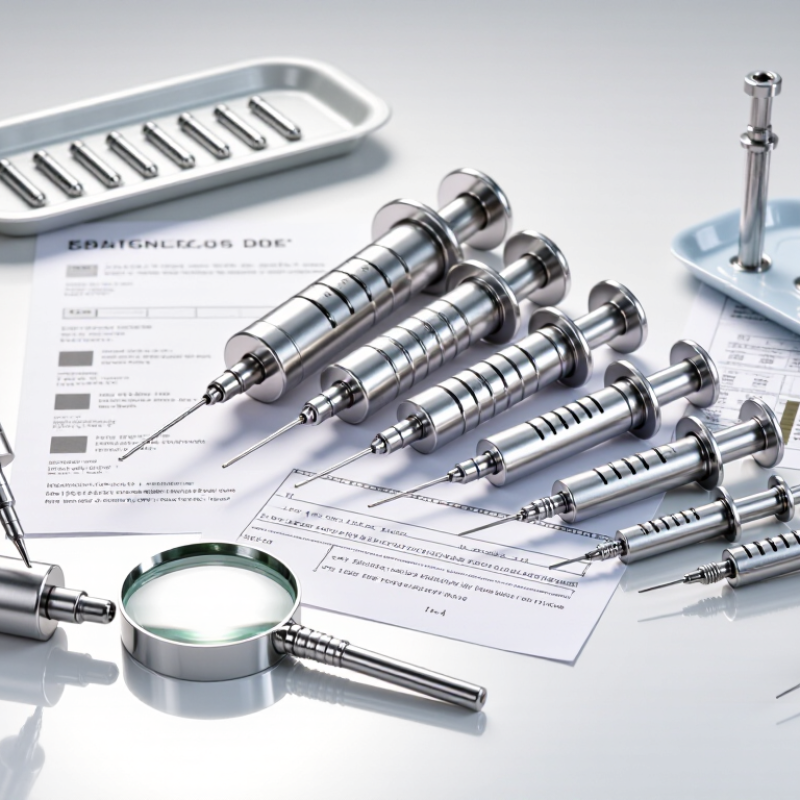
Chinese manufacturers supply several stainless steel syringe types for medical, veterinary, laboratory, and industrial applications. Reusable veterinary syringes often use polished steel barrels, adjustable dosage rings, and replaceable needles. Laboratory models may combine stainless steel bodies with glass cartridges for chemical resistance. Luer-lock designs support secure needle attachment. Some suppliers also produce all-steel dispensing syringes for oils, adhesives, and high-viscosity liquids.
The World Health Organization estimates that more than 16 billion injections occur globally each year. This volume increases demand for controlled dosing and dependable cleaning procedures. Medical syringes commonly prioritize smooth plungers and corrosion-resistant steel. Veterinary models need stronger handles and simple field maintenance. Industrial versions often require thicker walls and pressure-tested seals. The details matter.
Grand View Research’s 2024 medical syringe market assessment identifies safety, precision, and prefilled delivery as important market drivers. Stainless steel remains useful where repeated sterilization or chemical resistance is required. However, “reusable” does not mean maintenance-free. Poor polishing can trap residue near the tip. Weak seals can also create dosage variation. A reliable Chinese supplier should provide steel-grade information, dimensional tolerances, sterilization guidance, and batch inspection records. ISO 13485-based quality systems can strengthen traceability, but certification alone is not proof of every product’s performance. Buyers should request sample testing under actual temperature, pressure, and cleaning conditions.

China Top Stainless Steel Syringes Suppliers?
Choosing a Chinese stainless steel syringe supplier requires more than comparing prices. Start with documented quality systems, such as ISO 13485 certification, and verify the certificate’s scope and validity. Ask for material certificates showing the stainless steel grade, heat number, and supplier traceability. Surgical-grade claims need evidence, not attractive wording.
Inspect the syringe closely. The barrel should have a smooth internal surface, consistent dimensions, and no visible burrs. Check the plunger fit, tip connection, welding points, and resistance to corrosion after cleaning tests. Request samples from several production batches. A single perfect sample proves very little. Suppliers should explain inspection frequency, calibration records, and acceptance limits in clear language.
Reliable factories also control packaging, labeling, and batch records. Visit the production area when possible, or arrange an independent audit. Confirm how they manage nonconforming products and customer complaints. Ask for test reports from qualified laboratories, but review the methods behind each result. Reports without dates, sample numbers, or signatures deserve caution.
Price is useful, but it can hide weak traceability or inconsistent finishing. A lower quote may also reflect thinner material or limited inspection. That deserves questioning. Supplier evaluation is rarely flawless; production changes, staff turnover, and rushed orders can affect results. Keep written specifications, approve a reference sample, and monitor every shipment instead of trusting the first successful delivery.
China-based stainless steel syringe suppliers usually fall into four practical categories: reusable clinical syringes, precision laboratory syringes, veterinary instruments, and OEM/ODM manufacturers. Reusable models often use 304 or 316L stainless steel, with threaded plungers and replaceable seals. Laboratory suppliers focus on fine volume control, low dead space, and corrosion resistance. OEM factories provide engraved scales, custom fittings, packaging, and production under the buyer’s specifications.
According to Fortune Business Insights’ 2024 Syringes Market report, the global syringes market was valued at approximately USD 16 billion in 2023. Stainless steel products represent a smaller, specialized segment. Their value comes from durability and repeated sterilization, not simply low price. Buyers should request material certificates, dimensional inspection records, leak-test results, and sterilization validation. ISO 13485 quality systems and ISO 9626 requirements for stainless steel needle tubing can support supplier evaluation, while ISO 7886-1 may apply to relevant syringe designs.
A catalog can look impressive. Verification matters more. Suppliers serving hospitals should show batch traceability, cleaning controls, and documented autoclave-cycle testing. Laboratory suppliers need evidence of volume accuracy and plunger smoothness. OEM suppliers should provide pilot samples before mass production. One weakness remains: some listings describe “stainless steel” without identifying the exact alloy or wetted components. That detail deserves written confirmation. Supplier audits, sample testing, and controlled specifications reduce this uncertainty, although they cannot replace local regulatory review.
China’s top stainless steel syringe suppliers should be judged by evidence, not catalog photos. The WHO estimates that roughly 16 billion injections occur worldwide each year. That volume makes dimensional accuracy and contamination control operational priorities. ISO 13485 certification supports a controlled quality system, but certification alone proves little about one syringe design. Request batch records, material certificates, inspection plans, and sterilization validation.
Material selection deserves closer attention. Many manufacturers use 304 stainless steel for general components, while 316L can offer better resistance in demanding environments. The choice still depends on fluid compatibility, surface finish, and cleaning conditions. Ask for the steel grade, hardness range, passivation method, and corrosion-test results. ISO 7886 provides performance requirements for sterile, single-use syringes, including leakage and functional testing. A supplier should show test results linked to specific production lots.
Customization may include barrel capacity, needle length, wall thickness, tip geometry, graduations, and low-dead-space design. Laser markings can improve readability, yet excessive heat may affect surface quality if poorly controlled. Suppliers should provide drawings, tolerance tables, sample approvals, and change-control procedures. This is where practical experience matters. A prototype can look excellent and still fail repeated plunger-force testing. That weakness is easy to miss. Independent laboratory verification, traceable sampling, and a documented complaint process make comparisons more reliable. Some suppliers may resist sharing raw data; that should prompt careful reflection before qualification.
Material selection directly affects strength, corrosion resistance, sterilization compatibility, and the customization options available for stainless steel syringes and related precision components.
The chart shows representative minimum tensile-strength requirements for commonly specified stainless steel grades. Values are based on widely used ASTM material specifications: 304 stainless steel at 515 MPa, 316L stainless steel at 485 MPa, and precipitation-hardening 17-4 PH stainless steel in the H900 condition at approximately 1310 MPa. Final performance depends on material certification, heat treatment, tube tolerance, surface finishing, cleaning, and inspection requirements.
China Top Stainless Steel Syringes Suppliers?
How to Select the Right Chinese Stainless Steel Syringe Supplier
Choosing a Chinese stainless steel syringe supplier requires more than comparing prices. Check the steel grade, dimensional tolerance, surface finish, and connection accuracy. Ask whether each batch includes material certificates and inspection records. These documents support traceability and reveal how seriously the supplier controls quality. A clear answer matters.
Request samples before placing a large order. Examine the barrel under strong light for scratches, burrs, discoloration, or uneven polishing. Test the plunger movement with the intended fluid or application. It should move smoothly without excessive force or leakage. Ask for drawings, packaging details, and production lead times. Small details often expose larger process weaknesses.
A reliable supplier should explain its quality system without vague promises. Confirm incoming inspection, in-process checks, final inspection, and lot identification. An on-site or video audit can show whether the listed equipment actually exists. Communication also deserves attention. Can the team answer technical questions in clear English and report problems quickly?
Do not trust the lowest quotation automatically. It may exclude testing, protective packaging, or replacement terms. I have seen sourcing plans focus heavily on unit cost and overlook delivery damage. That mistake is easy to make. Compare the full landed cost, payment conditions, minimum order quantity, and after-sales response. A trial order can reveal more than a polished presentation, although even a successful sample cannot guarantee every future batch.
| Evaluation Dimension | Suggested Weight | Measurable Requirement | Recommended Supplier Evidence | Scoring Guidance |
|---|---|---|---|---|
| Material Grade and Traceability | 20% | Confirm the specified stainless steel grade, such as 304 or 316L, according to the product application. Require heat or lot identification for each production batch. | Material certificate, chemical composition report, mechanical-property report, lot number, and certificate traceability to the delivered goods. | 5 points: grade and lot are fully traceable; 3 points: grade is stated but traceability is incomplete; 0 points: no objective material documentation. |
| Dimensional Accuracy | 15% | Define critical dimensions before quotation, including barrel or body diameter, wall thickness, plunger fit, nozzle dimensions, and overall length. | Approved engineering drawing, tolerance table, inspection report, calibrated measuring equipment record, and first-article inspection sample. | 5 points: all critical dimensions meet the approved drawing; 3 points: minor deviations require approval; 0 points: no controlled drawing or inspection record. |
| Surface Finish and Corrosion Resistance | 15% | Specify surface condition, polishing requirements, weld or joint finish, burr limits, and resistance requirements for the intended fluid or environment. | Surface-finish specification, visual inspection standard, passivation or electropolishing records where applicable, and corrosion-test results when required. | 5 points: documented finish and verification method; 3 points: visual inspection only; 0 points: uncontrolled surface condition. |
| Leakage and Functional Performance | 15% | Establish acceptance limits for leakage, plunger force, pressure resistance, dispensing accuracy, and repeated-use cycles when the syringe is reusable. | Product-specific test method, test equipment details, batch inspection records, sample test results, and nonconformance procedure. | 5 points: requirements are quantified and batch-tested; 3 points: testing is performed but limits are unclear; 0 points: no functional validation. |
| Quality Management System | 12% | Use a documented quality system covering incoming inspection, process control, final inspection, calibration, corrective action, and complaint handling. | Current ISO 9001 or ISO 13485 certificate when applicable, certificate scope, audit reports, quality manual, and corrective-action records. | 5 points: valid certificate matches the manufacturing scope; 3 points: documented system without independently verified certification; 0 points: no formal quality system. |
| Regulatory and Product Documentation | 10% | Match documentation to the intended market and product use. Do not treat a general factory certificate as proof of medical-device compliance. | Technical file, declaration or certificate required by the target market, risk documentation, labeling information, and applicable test reports. | 5 points: documentation is complete and product-specific; 3 points: partial documentation; 0 points: unsupported regulatory claims. |
| Production Capacity and Lead Time | 8% | Compare capacity against the required monthly quantity, tooling needs, sampling schedule, production lead time, and peak-season contingency. | Capacity statement, production schedule, sample lead-time commitment, tooling plan, and evidence of production-site control. | 5 points: capacity and delivery plan are demonstrated; 3 points: capacity is claimed but not verified; 0 points: no reliable schedule. |
| Packaging, Cleanliness, and Shipping Protection | 5% | Define individual protection, moisture control, carton strength, identification labels, and cleanliness requirements based on the product application. | Packaging specification, packing photos, carton test information, cleanliness controls, and completed pre-shipment inspection report. | 5 points: packaging is validated for transport; 3 points: standard packaging only; 0 points: frequent damage or unclear packing controls. |
| Total Selection Score | 100% | Use weighted scores only after document review, sample inspection, and confirmation of the intended application. | ||